She built wells, not monuments
Ahilyabai Holkar ruled Malwa for twenty-eight years and spent it on rest-houses, ghats and roads. What her reign asks of a samaj like ours.
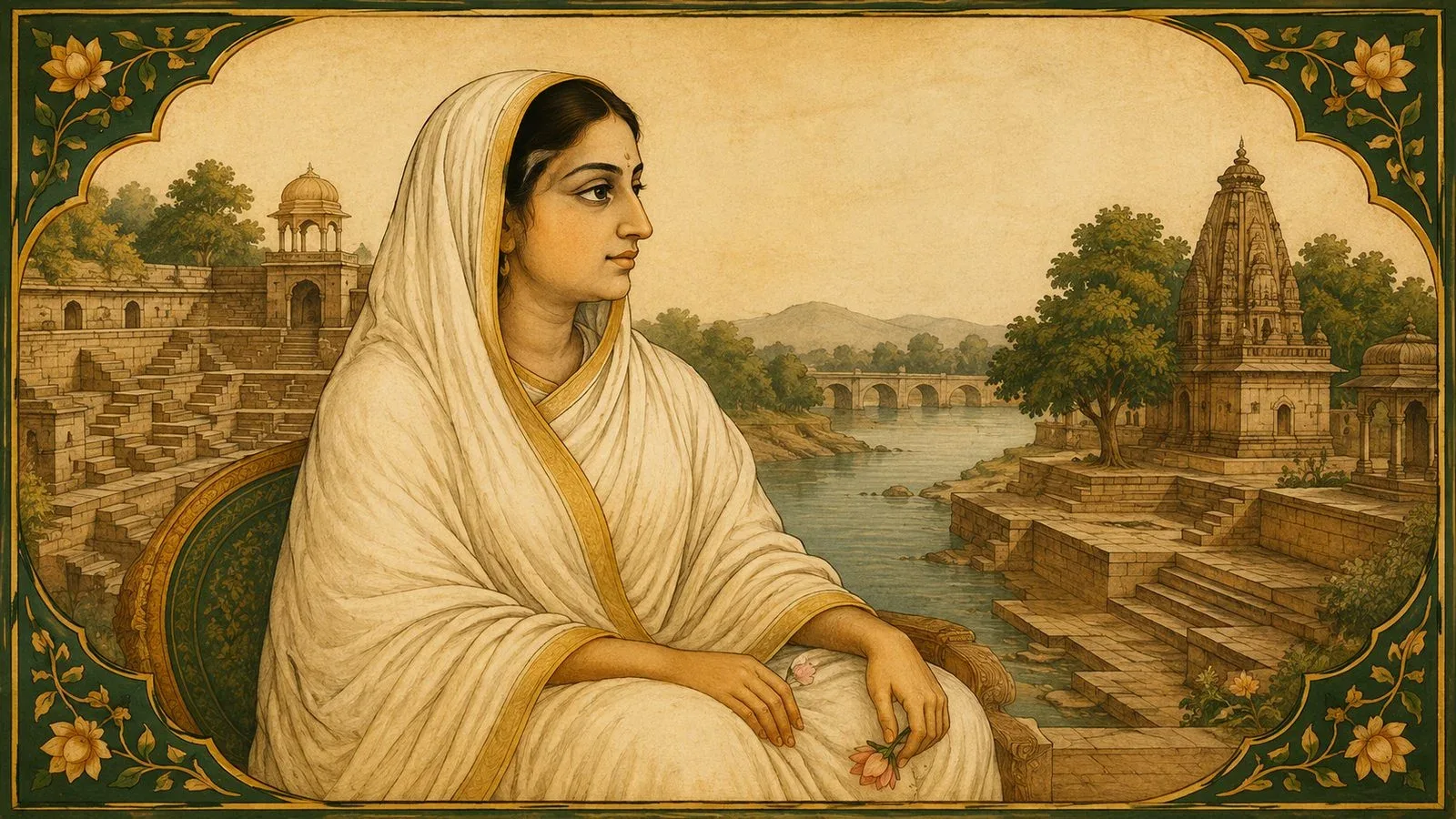
There is a particular kind of ruler our history books tend to skip. Not the conqueror, not the martyr — the administrator. The one who governs for decades without a famous battle, and leaves behind roads instead of legends.
Ahilyabai Holkar was that ruler. She took charge of Malwa in 1767, after losing her husband and then her son, and governed until her death in 1795. Twenty-eight years. Long enough to be judged on what she actually built rather than what she promised.
And what she built is the point. Wells and stepwells across her territory. Ghats on the riverbanks so people could reach the water safely. Rest-houses on the trade roads for travellers who had nowhere to sleep. Temples repaired as far away as Kashi and Somnath, hundreds of miles outside her own borders. Roads. Bridges. The unglamorous infrastructure of ordinary life.
She did not build a great palace for herself. She is not remembered for a coronation or a conquest. She is remembered because two and a half centuries later, some of the wells still hold water.
Three things her reign actually teaches
Not as a story about a queen. As a working method.
Build the thing people use daily
A well serves a village every morning for two hundred years. A monument is admired once. When a community has limited means, the choice between the two is the whole test of whether its leaders are serious.
Spend beyond your own boundary
She funded repairs at sites far outside Malwa, where she gained nothing politically. A samaj that only helps its own street is not a samaj. It is a street.
Govern in the open, and personally
She is recorded as hearing petitions herself, daily. Not through officials, not by decree. If you want people to trust a body with their money and their children’s futures, they have to be able to reach a person.
An uncomfortable comparison
It would be easy to claim her as a source of pride and leave it there. Plenty of organisations do exactly that — put a great name on the wall and carry on unchanged.
We would rather use her as a measuring stick, because she sets a genuinely awkward standard. She spent public money on things that outlast the person who ordered them. She did not hold ceremonies for work she had not finished. She did not confuse being seen to help with helping.
That is a difficult example for a young organisation. It is much easier to announce a scholarship than to fund one, easier to plan a sammelan than to hold one, easier to publish a photograph of a gathering than to gather anyone. We have tried to say plainly on this site which of our own work is real and which is still intention.
The honest position today: our scholarship fund is being built and has awarded nothing. Our Executive Committee is forming and has not been seated. Our first gathering has no date. Every one of those sentences is uncomfortable to write, and every one of them is the truth.
Help us build something that lasts
Membership is free. The scholarship fund grows only when our own families decide it should.