Cancer Treatment in India: Screening, Medicines and How to Choose the Right Hospital
A plain-language guide for Pal families — prevention, screening, treatment options, leading medicines, top cancer hospitals, and the government schemes that can lower cost.
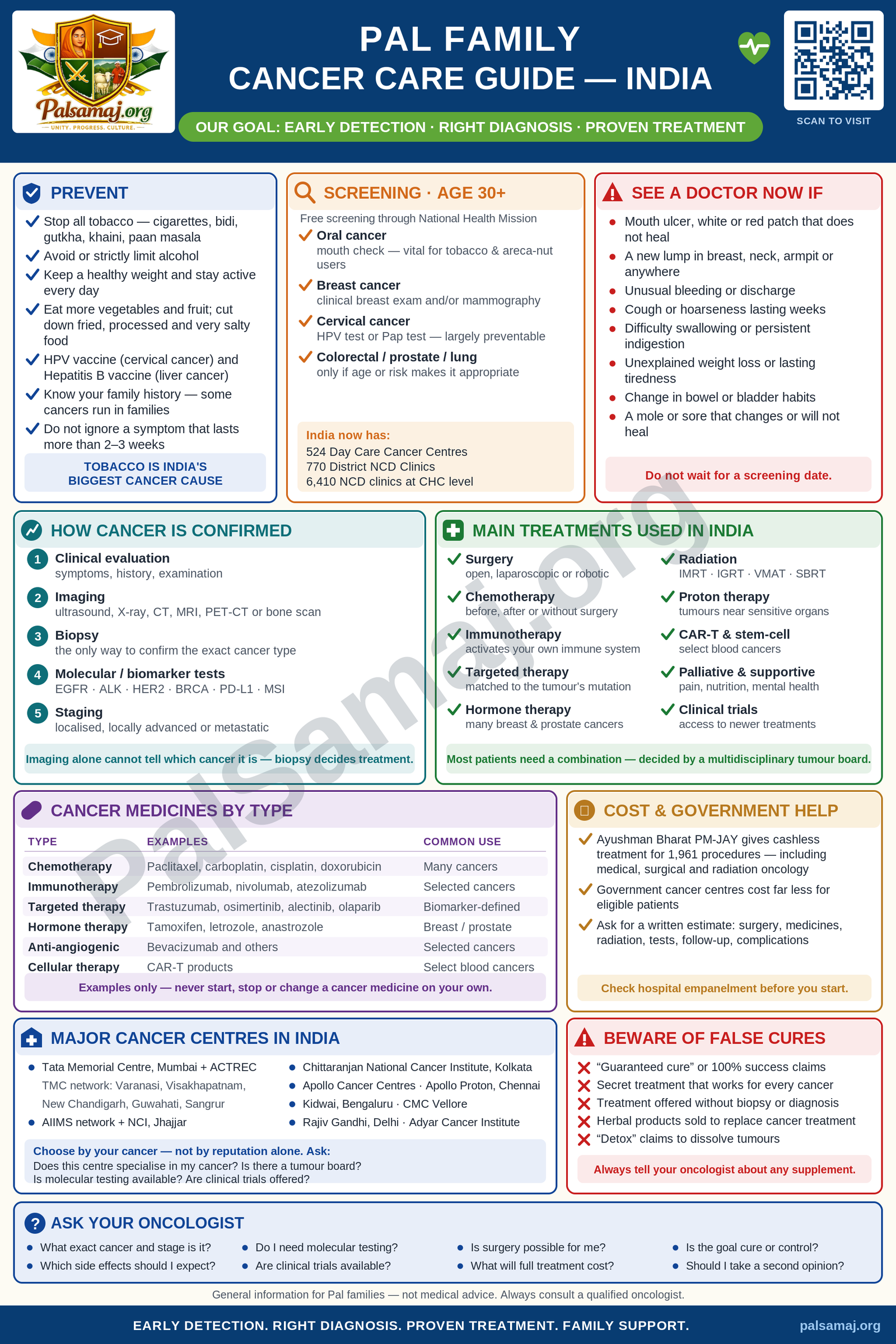
Cancer is one of the most important health challenges facing India. At the same time, cancer care in the country has advanced rapidly — major public and private institutions now offer modern surgery, radiation oncology, chemotherapy, immunotherapy, targeted medicines, molecular testing, precision oncology, cellular therapies and clinical trials.
For patients and families, the amount of information can be overwhelming: which cancer medicine is best? Which hospital should you choose? Should you have chemotherapy, immunotherapy, targeted therapy or radiation? What screening should you have? When is a PET-CT or biopsy needed?
The most important answer is this: there is no single best cancer medicine or best cancer hospital for every patient. The right treatment depends on the type of cancer, its stage, pathology, molecular characteristics, the patient’s overall health, and the expertise of the treating oncology team.
India now has a broad network of cancer centers — from major government institutions and specialist cancer institutes to large private hospital networks. As of July 2026, the Government of India reported 770 District NCD Clinics, 524 Day Care Cancer Centres and 6,410 NCD clinics at Community Health Centres nationwide, with population-based screening for oral, breast and cervical cancers under the National Health Mission for people aged 30 and above.
Why Early Cancer Detection Matters
Cancer is often easier to treat when detected before it has spread extensively. Early detection can open more treatment options and, for many cancers, substantially improve the chances of successful treatment.
Screening does not mean everyone should have every possible cancer test every year. The appropriate test depends on age, sex, family history, tobacco and alcohol exposure, previous cancer, genetic risk, symptoms and personal medical history. Anyone with concerning symptoms should seek medical evaluation rather than waiting for a routine screening appointment.
Cancer Prevention: What Can People Do?
- Stop tobacco. Tobacco is one of the most important preventable causes of cancer — cigarettes, bidis and smokeless tobacco all raise cancer risk.
- Limit alcohol. Reducing or avoiding alcohol lowers the risk of several cancers.
- Maintain a healthy weight. Regular activity and a balanced diet support long-term prevention.
- Get vaccinated. The HPV vaccine reduces HPV-related cancers; hepatitis B vaccination helps prevent liver cancer linked to chronic infection.
- Know your family history. A strong family history may justify genetic counseling and testing.
Cancer Screening in India
1. Oral cancer screening
Important given India’s burden of tobacco and areca-nut use. Persistent ulcers, white or red patches, unexplained bleeding, a lump, difficulty swallowing or a sore that won’t heal should be evaluated promptly.
2. Breast cancer screening
One of the most common cancers in Indian women. Depending on age and risk, this may involve clinical breast examination and/or mammography.
3. Cervical cancer screening
Largely preventable through HPV vaccination and screening — HPV testing, cytology/Pap testing, or other approved methods.
4. Colorectal and other cancer screening
May be appropriate based on age, risk factors and clinical circumstances. The Indian Council of Medical Research maintains disease-specific oncology guidelines.
What Happens When Cancer Is Suspected?
- Clinical evaluation — symptoms, history and physical findings.
- Imaging — ultrasound, X-ray, CT, MRI, PET-CT or bone scan.
- Biopsy — usually essential, since imaging alone can’t identify the cancer type.
- Molecular and biomarker testing — EGFR, ALK, ROS1, BRAF, KRAS, HER2, BRCA1/2, MSI/MMR, PD-L1 and more.
- Staging — localized, locally advanced or metastatic.
The Major Types of Cancer Treatment in India
Modern oncology generally combines several approaches: surgery (open, laparoscopic, robotic), chemotherapy, immunotherapy (checkpoint inhibitors such as pembrolizumab, nivolumab, atezolizumab), targeted therapy matched to molecular drivers like EGFR, HER2, ALK and BRCA-related pathways, hormone therapy for hormone-dependent breast and prostate cancers, and radiation therapy including IMRT, IGRT, VMAT, brachytherapy and proton beam therapy.
India has proton-therapy capability through Apollo Proton Cancer Centre in Chennai, described as South Asia’s first proton therapy center. CAR-T cell therapy and stem-cell transplantation are available for selected blood cancers at centers with specialized expertise, and palliative and supportive care — pain control, nutrition, psychological support — can be provided alongside active treatment.
Cancer Medicines by Category
There is no universal ranking of “best” cancer medicines — a better way to think about them is by category (examples only, not recommendations for an individual patient):
| Category | Examples | Common use |
|---|---|---|
| Chemotherapy | Paclitaxel, carboplatin, cisplatin, doxorubicin | Many cancers |
| Immunotherapy | Pembrolizumab, nivolumab, atezolizumab | Selected cancers |
| Targeted therapy | Trastuzumab, osimertinib, alectinib, olaparib | Biomarker-defined cancers |
| Hormone therapy | Tamoxifen, letrozole, anastrozole | Selected breast/prostate cancers |
| Anti-angiogenic therapy | Bevacizumab and others | Selected cancers |
| Cellular therapy | CAR-T products | Selected blood cancers |
Leading Cancer Hospitals and Cancer Centers in India
Rather than one hospital being definitively “No. 1,” patients should choose based on cancer type, required treatment, physician expertise, clinical-trial access, technology, affordability and location.
- Tata Memorial Centre — Mumbai and nationwide network (with ACTREC), now also in Varanasi, Visakhapatnam, New Chandigarh, Guwahati, Sangrur and Muzaffarpur.
- AIIMS and the National Cancer Institute, Jhajjar — medical and preventive oncology, extended to all 22 new AIIMS.
- Apollo Cancer Centres — 22 cancer centers, 360+ oncologists, proton therapy in Chennai.
- Chittaranjan National Cancer Institute — Kolkata, comprehensive cancer center with dedicated palliative care.
- Other major centers: Christian Medical College Vellore, Kidwai Memorial Institute (Bengaluru), Rajiv Gandhi Cancer Institute (Delhi), Adyar Cancer Institute (Chennai), HCG, Fortis, Manipal, Max Healthcare, Medanta, Narayana Health.
Can Cancer Treatment Be Affordable in India?
As of July 2026, the Government of India reported that Ayushman Bharat PM-JAY covers cashless treatment for 1,961 procedures across 27 medical specialties — including medical, surgical and radiation oncology — through empanelled public and private hospitals. Check current eligibility, hospital empanelment and benefit packages before beginning treatment.
How to Choose the Right Cancer Hospital
Instead of asking “which is India’s No. 1 cancer hospital,” ask: does the hospital specialize in my cancer? Is there a multidisciplinary tumor board? Is molecular testing available? Does it offer clinical trials? Does it have the required technology? Can the family afford the complete treatment? Is a second opinion appropriate?
Beware of “miracle” cancer treatments. Be cautious of anyone promising a guaranteed cure, a 100% success rate, a secret treatment, or a cure without diagnosis or biopsy. Always tell your oncologist about any supplement or alternative treatment — some can interact with cancer medicines.
Nutrition and Mental Health During Treatment
Nutrition is a core part of cancer care — a cancer dietitian can help build an individualized plan. Cancer affects the whole family; psychologists, social workers, counselors and support groups all play a role. Mental-health support is not optional — it’s part of comprehensive cancer care.
Questions Every Cancer Patient Should Ask
What exact type and stage of cancer do I have? Has the pathology been reviewed by an experienced cancer pathologist? Do I need molecular or biomarker testing? Is surgery possible? Could immunotherapy or targeted therapy help? What is the goal of treatment — cure, control or symptom relief? How much will treatment approximately cost, and what government programs can help? Should I get a second opinion?
Final Takeaway
The best cancer treatment is not necessarily the newest medicine, the most expensive hospital, or the most advanced machine — it is the one that is accurate, evidence-based, personalized, and delivered by the right specialists for the patient’s cancer and stage.
Know your risk. Avoid tobacco. Maintain a healthy lifestyle. Follow appropriate screening recommendations. Do not ignore persistent symptoms. Seek qualified medical advice early.
Want more guides like this?
Join Pal Samaj free and get new health, scholarship and community resources as they’re published.
Join Free Browse Health & WellnessGet more guides like this one
Get new health guides, scholarships and community news first.
Create your free membership in under a minute and become a Charter Member of our community. No fees, ever.