Cancer Treatment in the USA: Leading Medicines, Therapies and Cancer Hospitals
A practical guide for Pal families in the US — biomarker testing, leading medicines, NCI-Designated Cancer Centers, and how to choose the right care team.
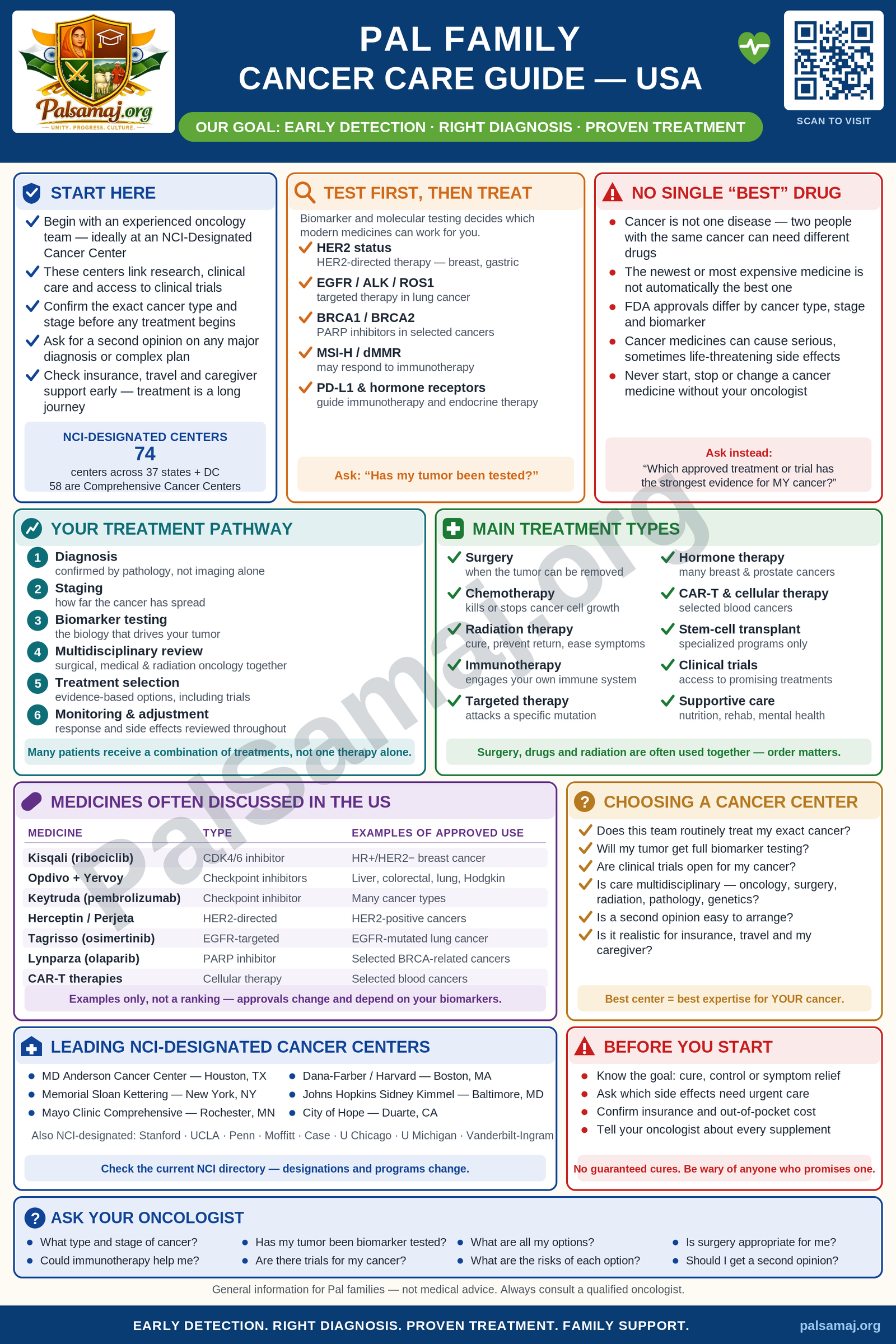
Cancer treatment has changed dramatically in recent years. Advances in precision medicine, immunotherapy, targeted therapies, hormone therapy, surgery and radiation have given many patients more treatment options than ever before.
An important point up front: there is no single “best” cancer medicine or therapy for every patient. The right treatment depends on the type of cancer, its stage, genetic and molecular characteristics, previous treatments, overall health and the goals of care. The National Cancer Institute (NCI) notes that many patients receive combinations of treatments rather than one therapy alone.
For patients seeking cancer care in the United States, a good starting point is an oncology team at an experienced cancer center — particularly an NCI-Designated Cancer Center, where research, clinical care and access to clinical trials are closely connected.
What Are the Main Types of Cancer Treatment?
Surgery. When a tumor can be safely removed, surgery may be the primary treatment, often combined with chemotherapy, radiation, immunotherapy or targeted therapy.
Chemotherapy. Kills cancer cells or stops their growth — still important for many cancers, frequently combined with other therapies.
Radiation therapy. High-energy radiation to cure certain cancers, reduce recurrence risk, shrink tumors before surgery, or relieve symptoms.
Immunotherapy. Helps the immune system recognize and attack cancer — checkpoint inhibitors are now central to treatment for numerous cancers.
Targeted therapy. Attacks particular molecular changes driving cancer growth — one reason biomarker testing has become so important.
Hormone therapy. Blocks or interferes with hormones that some breast and prostate cancers depend on to grow.
Cellular and advanced therapies. Stem-cell transplantation and cellular therapies for selected blood cancers, through specialized programs.
Leading Cancer Medicines and Therapies
Rather than asking which drug is universally “best,” patients should ask: “Which FDA-approved treatment or clinical trial has the strongest evidence for my specific cancer and biomarker profile?”
Kisqali (ribociclib) — Novartis
A CDK4/6 inhibitor, important in certain hormone receptor-positive, HER2-negative breast cancers. The FDA approved Kisqali with an aromatase inhibitor for adults with HR-positive/HER2-negative stage II or III early breast cancer at high risk of recurrence (2024, based on the NATALEE trial), and for certain adults with advanced or metastatic disease. This illustrates why “best cancer drug” can be misleading — Kisqali matters for the right tumor profile, not as a general breast-cancer treatment.
Opdivo (nivolumab) and Yervoy (ipilimumab) — Bristol Myers Squibb
Immune checkpoint inhibitors, sometimes combined for a stronger immune response. FDA-approved (2025) as first-line treatment for unresectable or metastatic hepatocellular carcinoma and for certain MSI-H/dMMR metastatic colorectal cancer; Opdivo is also approved with chemotherapy for certain resectable non-small-cell lung cancer, and, as of March 2026, for previously untreated stage III/IV classical Hodgkin lymphoma in patients 12 and older.
Other important cancer medicines
Illustrative examples only — not a ranking; approvals and appropriate uses change and depend on individual biomarkers:
- Pembrolizumab (Keytruda) — checkpoint inhibitor across numerous cancers
- Atezolizumab (Tecentriq) — immunotherapy for selected cancers
- Trastuzumab (Herceptin) / Pertuzumab (Perjeta) — HER2-directed treatment
- Osimertinib (Tagrisso) — targeted therapy for EGFR-mutated lung cancer
- Olaparib (Lynparza) — PARP inhibitor for selected genetic profiles
- CAR-T cell therapies — specialized cellular treatment for selected blood cancers
Leading Cancer Centers in the United States
There is no single hospital best for every cancer. A useful measure is NCI designation — Comprehensive Cancer Centers have particularly broad research, clinical and population-based programs.
- MD Anderson Cancer Center — Houston, TX
- Memorial Sloan Kettering — New York, NY
- Mayo Clinic Comprehensive Cancer Center — Rochester, MN
- Dana-Farber/Harvard Cancer Center — Boston, MA
- Johns Hopkins Sidney Kimmel — Baltimore, MD
- City of Hope — California
Also NCI-designated: Stanford, UCLA, University of Pennsylvania, Moffitt, Case Comprehensive, University of Chicago, University of Michigan, Vanderbilt-Ingram. Consult the current NCI directory, since designations change.
How to Choose the Right Cancer Hospital
Consider: expertise in your specific cancer, availability of molecular/biomarker testing, access to clinical trials, multidisciplinary care (medical, surgical, radiation oncology, pathology, genetics), ease of getting a second opinion, and practical factors like insurance, travel and caregiver availability.
Why Personalized Cancer Treatment Matters
Cancer is not one disease. Even two people with the same cancer type can have tumors with different molecular characteristics. Modern oncology combines: diagnosis → staging → biomarker testing → multidisciplinary review → treatment selection → monitoring → adjustment.
Questions to Ask Your Oncologist
What exact type and stage of cancer do I have? Has my tumor been tested for relevant biomarkers? Is surgery appropriate? Would immunotherapy or targeted therapy help? Are there clinical trials for my cancer? What are the risks of each option? Should I get a second opinion? Which cancer center has the greatest expertise in my specific cancer?
No guaranteed cures. The newest or most expensive drug is not automatically the best drug. Be wary of anyone who promises a guaranteed outcome.
The Bottom Line
The United States is home to some of the world’s most advanced cancer research and treatment programs. But the best treatment is the one supported by strong clinical evidence for the patient’s particular cancer, stage and biomarkers — not the newest or most expensive option. An excellent first step is a precise diagnosis and staging, biomarker testing, a full discussion of evidence-based options with a qualified oncology team, and an NCI-Designated Cancer Center or specialist second opinion when appropriate.
Want more guides like this?
Join Pal Samaj free and get new health, scholarship and community resources as they’re published.
Join Free Browse Health & WellnessGet more guides like this one
Get new health guides, scholarships and community news first.
Create your free membership in under a minute and become a Charter Member of our community. No fees, ever.